

Interview with John A. Lent
Bangladeshi cartoonist Mehedi Haque talks to the legendary comics scholar

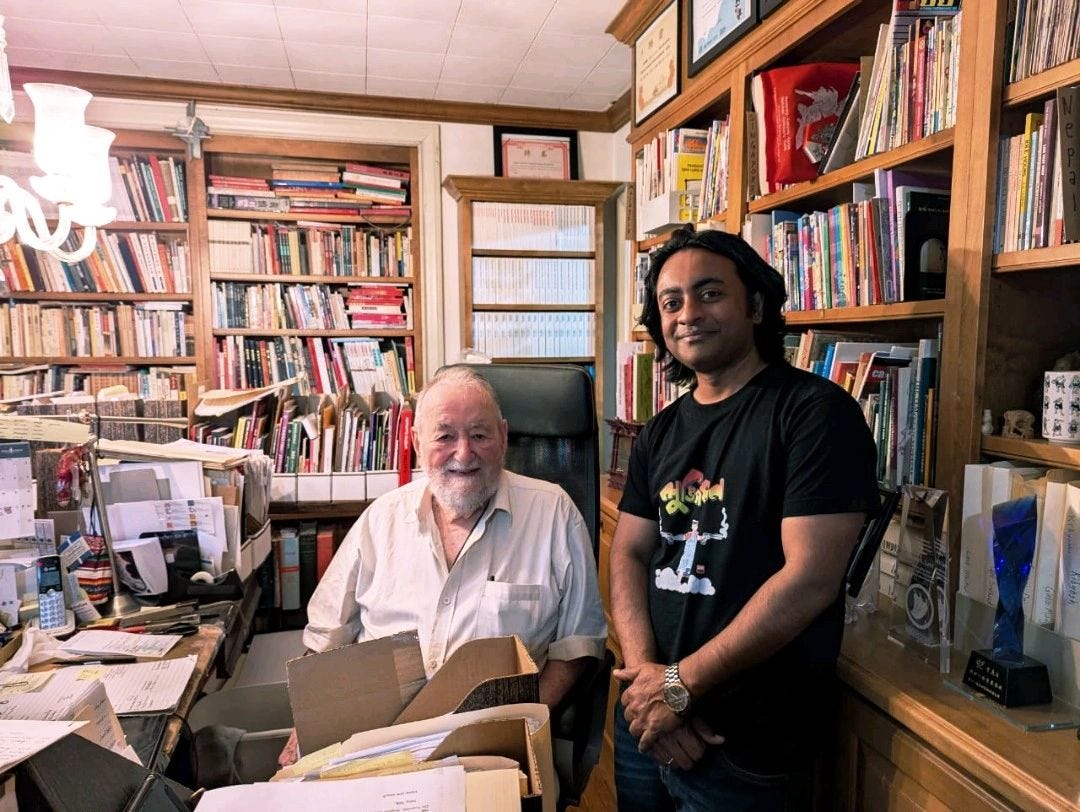
Mehedi Haque, editorial cartoonist from Bangladesh and member of Cartoon Movement, met with legendary cartoon scholar and teacher Dr. John A. Lent in the summer of 2025, and interviewed him about the past present and future of political cartooning around the world.
Lent passed away last month, and this is one of his last interviews. Below you will find an excerpt of the interview (mainly focusing on political cartoons), but you can listen to the full interview as well:
John A. Lent is widely regarded as one of the pioneers of comics and cartoon studies and among the most influential scholars in the field worldwide. A professor of mass communication for more than five decades, he played a crucial role in establishing comics, cartoons, and visual satire as legitimate subjects of academic research. He is the founder and longtime editor of the International Journal of Comic Art (IJOCA), one of the world’s leading scholarly publications dedicated to comics and cartooning.
Over the course of his career, Lent has authored or edited more than ninety books and countless research articles on comics, political cartoons, animation, and popular culture across Asia, the Caribbean, Oceania, and beyond. His personal archive containing thousands of rare books, original artworks, and historical documents is considered one of the most significant private collections related to cartooning and comic art in the world. Through his research, teaching, and publishing, John A. Lent has helped document and preserve the global history of cartooning while inspiring generations of scholars and artists alike. Lent passes away in 16th May, 2026 before his 90th birthday.
This interview was taken by Cartoonist Mehedi Haque in August, 2025 at John A. Lent’s house.
Mehedi Haque: How did you start getting interested in cartoons while in academics?
John A. Lent: I had an interest as early as the 1960s. At that time, I was in graduate school working on a PhD at Syracuse, and I did a little experiment because it was on the heels of the anti-comics campaign that was in the 1950s in the United States and all over the world. So I wanted to see if I could find out if children were being affected by comic books. And I did a little study in Syracuse, two fourth grade classes, and some of them saw the comic book and then took a personality tests, and the others didn’t see it. I didn’t see any effect.
But that stirred up some interest. In the early 1980s, I recall interviewing a Korean or Taiwanese cartoonist. Then in 1985, I did a little bibliography because there weren’t bibliographies of comic art. I did it and printed it illegally at Temple University and distributed free to a bunch of places, to mainly libraries. A guy named Joe Szabo, a Hungarian cartoonist, apparently saw a news article or something about it, and he called me up and said he wanted to start a magazine. We met at a McDonald’s in 1986, and we started to bring out this magazine titled Witty World. At that time, we didn’t have an office, and we used to work on a computer in his bedroom and his wife would stay out while we were working. Sometimes, we would go on until 1 or 2 in the morning, and then she could go to bed. Later, he developed an office on the third floor of his home. Anyway, it was a success. It was a quality paper type and color and all of that.
But Joe was trying to make a living from that, but it wasn’t possible to sell that many copies. We published, I think, 21 issues. After that, the money ran out. The magazine introduced many people for the first time to the concept of international comics and cartoons. In this country, most people thought everything came out of the United States, and maybe some from Great Britain.
By the late 1990s, I was going to conferences, because some students were now doing comics as their PhD dissertations, especially at the University of Connecticut. And I tried to encourage students to do something on comics or cartoons. Maybe 15, 20 students (from China, Korea, Taiwan, Cuba, Turkey and India) did their PhDs under my supervision on comics. I was taking them to different conferences, and we would have a panel on comics. When we would go to the Popular Culture Association, which has a comics division, the first session would be on Superheroes and there would be 20/30 people. The next one would be on Asian comics and four or five people would show up. I was upset by that, and I wrote a little article saying that three is something else in the world besides superhero comics from Marvel and DC. And it started to grow from there. At those conferences, I also heard these newly minted PhDs say we need a journal, but that it would be too expensive. In 1998, at one of our conferences, I handed out a mimeograph piece of paper to maybe 30, 40 people and said, we have a journal now.
Much editorial cartooning has become guided cartooning. It’s guided by the editor, the publisher, or the conglomerate that owns it.
Haque: What do you think about cartooning in Bangladesh and South Asian?
Lent: I think cartoonists in Bangladesh are increasing the professionalization of the art, and there are things in Bangladesh now that many countries don’t have. You have a cartoonist association and you are starting a cartoon academy.
As for the cartooning, I would talk more generally about what’s happening in not just in Asia, but many parts of the world, including the United States. I think that political cartooning is on its deathbed. I hope that’s not the case, but I’m seeing that so much editorial cartooning has become what I call guided cartooning. It’s guided by the editor, the publisher, or the conglomerate that owns it. I think that’s a more dangerous type of control than government control, because if you know it’s the government, you can find sneaky ways to get around the government, right? And cartoonists know how to do that very well, but when it’s your boss, it’s a different story.
Haque: How did this happen?
Lent: When I was growing up, there were editorial cartoonists in small newspapers. That’s fading. About 100 years ago, there were 2200 cartoonists working in different newspapers , then went down 400, and now it’s probably 130.
It’s a matter of survival. In the Philippines, there was a cartoonist, he was young and he was very hard hitting, but he left and went to Singapore. I said to him, why would you do that? He said: ‘I have five children. In the Philippines I had freedom, but I didn’t have money for rice. But in Singapore, I don’t have freedom, but I have the money.’
In this country, if the publisher says ‘we don’t need that position anymore’, which is happening, then it’s gone. Joel Pett worked for the Lexington newspaper for over 30 years. He was let go. In some cases they’ll have early buyouts: if you retire now, we’ll give you a little bonus. And maybe the public, doesn’t care that much anymore, because they can get everything on their cell phone now. Many people are no longer reading newspapers or the cartoons that are in them.
Haque: Do you see a future for cartoons?
Lent: I think they’ll continue, but they’ll continue in different forms. Some countries don’t have many comic books, but they do have web comics and many people prefer these webtoons, because it’s one continuous nonstop scroll. You don’t have to flip anything, no next button, just scroll. As for the political cartoon, I think some of that’s continuing online too, but I don’t know how effective it is.